It’s Part 2 of the roaming review of Singapore’s local SIM card. Just like the Roaming Review done for South Korea in the previous article, this article will share which is the best SIM to roam in Japan with.
Take your pick below!
Postpaid Roaming
Provider
Best Rate
Validity
Note
SingTel
2GB for $20
30 days
N.A.
StarHub
3GB for $20
30 days
N.A.
M1
$25 Data Passport i.e. on a $25 for 30GB SIM-only Plan 1GB for $1.67
Monthly Cycle
Data is from local bundle
TPG
No roaming to Japan yet
Circles.Life
100MB for $5
PAYG
N.A.
GOMO
2GB for $10
10 days
N.A.
giga!
1GB for $5
5 days
N.A.
Zero1
1GB for $18
30 days
N.A.
Zero SG
No roaming services
MyRepublic
1GB for $20
30 days
N.A.
redONE
1GB for $614.40 (based on $0.60 per MB)
PAYG
N.A.
Vivifi
1GB for $35
30 days
N.A.
Grid Mobile
1GB for $18
30 days
N.A.
Prepaid Roaming
Provider
Best Rate
Validity
Note
SingTel
2GB for $28
30 days
N.A.
StarHub
4GB for $25
30 days
comes with 16GB local data 4GB can be used in SG free 10GB in SG every Sunday
M1
2GB for $28
10 days
10 minutes overseas call
Vivobee
no roaming services
Just like travellers to South Korea, the best local SIM to bring to Japan would still be M1’s 30GB SIM-only plan as with the $25 Data Passport added on, you would be able to use your entire data bundle in both Singapore and Japan. This means that your per GB price will be driven down to $1.67 and after coming back to Singapore, you will still be able to continue using your remaining data bundle. After all, since your local data bundle is unused in Singapore while you are in Japan, you might as well bring it there to use.
If you’re a GOMO or giga! user, the rates offered are also attractive as add-ons. GOMO users can purchase Japan roaming at 2GB for $10 for 10 days while giga! users can purchase it at 1GB for $5 for 5 days, which means that both roaming products are pretty similar, except that GOMO’s is slightly better.
If you are using other Postpaid options, there is no need to port out to M1, GOMO or giga! to use the roaming services to Japan. Simply purchase a StarHub Happy SIM and purchase the 20GB for $25 data plan. This will give you 4GB to roam in Japan, and 16GB in Singapore. Additionally, you also get 10GB free in Singapore on Sundays. If you have any remaining data from the 4GB after coming back from Japan, you can use the leftover data in Singapore as well.
The following table shows the recommended options to Japan as discussed above.
Provider
Type
Product
Data & Price
Validity
Price/GB
Other Benefits
M1
Postpaid
$25 Data Passport
N.A.
Monthly
$1.67
Unused data can be used in SG
GOMO
Postpaid
Roaming Data Pump
2GB for $10
10 days
$5
N.A.
giga!
Postpaid
gigaRoam APAC
1GB for $5
5 days
$5
N.A.
StarHub
Prepaid
WOW Data Plan
4GB for $25
30 days
$6.75
Unused data can be used in SG. 16GB more in SG. free 10GB in SG every Sunday.
With growing affluence, more and more Singaporeans are travelling overseas, be it for work or holiday, at least once per year, and with the widespread fandom of K-pop and K-drama, South Korea is one of the top destinations.
However, what local SIM card is the best for you to use to roam in South Korea? After all, there are so many things to be posted on Instagram, so many places to search for with Google Maps or Naver Maps, and so many translations needed with Google Translate.
Take your pick below!
Postpaid Roaming
Provider
Best Rate
Validity
Note
SingTel
2GB for $20
30 days
N.A.
StarHub
3GB for $20
30 days
N.A.
M1
$25 Data Passport i.e. on a $25 for 30 SIM-only Plan 1GB for $1.67
Monthly Cycle
Data is from local bundle
TPG
No roaming to South Korea yet
Circles.Life
100MB for $3
PAYG
N.A.
GOMO
2GB for $10
10 days
N.A.
giga!
1GB for $5
5 days
N.A.
Zero1
1GB for $18
30 days
N.A.
Zero SG
No roaming services
MyRepublic
1GB for $20
30 days
N.A.
redONE
1GB for $614.40 (based on $0.60 per MB)
PAYG
N.A.
Vivifi
1GB for $35
30 days
N.A.
Grid Mobile
1GB for $18
30 days
N.A.
Prepaid Roaming
Provider
Best Rate
Validity
Note
SingTel
2GB for $28
30 days
N.A.
StarHub
4GB for $25
30 days
comes with 16GB local data 4GB can also be used in SG free 10GB in SG every Sunday
M1
2GB for $28
10 days
10 minutes overseas call
Vivobee
no roaming services
As seen above, the best Postpaid plan to be on for South Korea travellers would be M1’s $25 for 30GB SIM-only plan. With an addition of a $25 Data Passport, users would be able to use their entire data bundle in South Korea as well (after all, your 30GB won’t be used in Singapore while you’re in Korea, so might as well use it there), driving the per GB roaming price to $1.67.
However, the rates offered by GOMO and giga! are also attractive, an average of $5 per GB. However, the validity for giga! may not be attractive as hardly anyone travels to South Korea for just 5 days, so users would have to purchase its gigaRoam APAC twice for 2GB for $10 (10 days).
If you’re on other Postpaid providers other than M1, GOMO or giga!, fret not. You can simply purchase a StarHub Prepaid Happy SIM and purchase the $25 WOW Data Plan. It comes with 20GB (16GB for local data only, 4GB for local and roaming – with South Korea being one of the destinations). While the upfront price is $25, you do get 4GB for roaming, driving the per GB price down to $6.75. What’s more, you also get 16GB back for use in Singapore as well as free 10GB every Sunday. The validity for the 4GB is also sufficient at 30 days, making it a strong roaming proposition.
Overall, the following are the recommended options as discussed above.
Provider
Type
Product
Data & Price
Validity
Price/GB
Other Benefits
M1
Postpaid
$25 Data Passport
N.A.
Monthly
$1.67
Unused data can be used in SG.
GOMO
Postpaid
Roaming Data Pump
2GB for $10
10 days
$5
N.A.
giga!
Postpaid
gigaRoam APAC
1GB for $5
5 days
$5
N.A.
StarHub
Prepaid
WOW Data Plan
4GB for $25
30 days
$6.75
Unused data can be used in SG. 16GB more in SG. free 10GB in SG every Sunday.
Every telco plan is different in their own way, and as the local telco market becomes more and more crowded, telcos are pulling all stops to try and capture their own customer base.
Niche segment plans such as Vivifi’s Family Sharing plan and redONE’s Data without Borders have emerged to capture different niches, but what are the best and worst plans for each segment in the market? Read on to find out more.
Best Plan for lowest price/GB
Grid Mobile
Best Plan for heavy talktime users
Vivifi Lite
Best plan for heavy all-round users
MyRepublic Unlimited Plan
Best plan for medium all-round users
GOMO
Best plan for light all-round users
Vivobee Unlimited Plan $1
Best plan for light users to add on usage
Vivifi Lite
Best plan for medium users to add on usage
Circles.Life Base Plan
Best plan for frequent Malaysia goers
redONE Amazing8
Worst plan for lowest price/GB
Vivifi Me
Worst plan for talktime users
Circles.Life Base Plan
Worst unlimited plan
Zero1 9GB to Unli
Worst light plan
Circles.Life $5 Plan
Best Plan for Lowest Price/GB There’s really no dispute for this one. If you’re looking at purely 4G/4G+ data speeds, Grid Mobile offers the best deal among all players at $24.90 for a whooping 40GB. This means that your per GB price is only $0.63.
Best Plan for Heavy Talktime Users While modern telco plans prioritises on data and gives lesser talktime and SMS, Vivifi Lite are more generous with their talktime. For $8.80 a month, you get 500 minutes outgoing calls and free incoming calls, coupled with 3GB data and 20 SMS. That’s less than 2 cents per outgoing call minute.
Best Plan for Heavy All-round Users While the recent hype for mega plans have been around Giga’s new 50GB plan for $45, with 10000 minutes outgoing calls and 10000 SMS, MyRepublic’s Unlimited Plan at $48 actually offers the better deal. With 3GB a day, adding up to 90GB (unlimited throttled speed thereafter) a month, and 8000 minutes outgoing calls and 8000 SMS, you may be paying $3 less per month with Giga and getting 2000 minutes and 2000 SMS more, but you are missing out on 40GB of data. Weighing these 2 plans, MyRepublic would appeal more to heavy all-round users.
Best Plan for Medium All-round Users Unlike certain beliefs that Circles.Life offer the cheapest plan in town ($18) for a medium plan (20GB), the Base Plan offered by Singapore’s first MVNO pales in comparison with GOMO’s plan, the latter offering 20GB for $20, with 200 minutes outgoing calls, free incoming calls and 200 SMS. On the contrary, Circles.Life’s price tag of $18 only applies to port-in users, new users have to pay $28, and talktime is only at 100 minutes with no free incoming calls. That means your 100 minutes is shared between outgoing calls and incoming calls. To round that up, you only get 25 SMS. Even for a port-in user, it may be better off to pay $2 more for GOMO.
Best Plan for Light All-round Users While Circles.Life boast the cheapest Postpaid plan in the market with its $5 Plan for light users, users with minimal usage may actually derive a better deal with Vivobee’s Unlimited Plan $1. You can be forgiven for never hearing about Vivobee as the Prepaid MVNO riding on StarHub’s network only offers Prepaid plans with their target segment being migrant workers.
That being said, its Unlimited Plan gives you 500MB, 30 minutes outgoing calls, free incoming calls and 30 SMS per month for 12 months for just $1. That is a mere 8 cents per month. Circles.Life’s old Flexi Plan of $0 for 1GB, 30 minutes talktime (no free incoming again) and 10 SMS used to be the better deal, but they have since retired it and replaced it with the $5 Plan; 2GB, 50 minutes talktime, no free incoming and 25 SMS, which makes Vivobee’s 8 cents plan look way more attractive.
Best Plan for Light Users to add on Usage Even for light users, there are times when they use more, and Vivifi Lite fills this gap. While the monthly price of $8.80 is more expensive than Vivobee’s Unlimited Plan ($0.08) and Circles.Life’s $5 Plan, it already offers more to begin with, with cheaper add-on options.
Vivifi Lite
Vivobee Unlimited
Circles.Life $5 Plan
Price
$8.80
$0.08
$5
Data
3GB
500MB
2GB
Talktime
500 min
30 min
50 min
Free Incoming Call?
Yes
Yes
No
SMS
20
30
25
Add-ons
$3.21 for 1GB + 100 min + 100 SMS
$5 Bee Lite for 1GB + 50 min + 50 SMS
$8 for 1GB $12 for 2GB $5 for 30 min $10 for 200 min + Free Incoming Call
While the add-on price difference between Vivifi Lite and Vivobee is only $1.79, the former already starts with 2.5GB and 470 minutes more, and as light users add on more usage, Vivifi Lite would prove to be the cheaper option.
Best Plan for Medium Users to add on Usage If you’re a medium range users, hovering around 20GB, with occasional need for talktime (excluding VoIP calls) and SMS, then Circles.Life’s Base Plan add-ons may be what you need when you have to use more in certain months (e.g. holidays). Unlike other telcos which offer immediate unlimited plans, Circles.Life offer an unlimited data add-on for $20 (first 20GB at 4G/4G+ speeds, followed by throttled speeds), unlimited outgoing call add-on at $8, and unlimited incoming call add-on at $2 (unlike other telcos, Circles.Life does not offer free incoming calls).
With all these various add-on options, Circles.Life offers users the freedom to customise their usage according to the category of their need at the moment, be it data or calls, and not a full bundle of data and call unlimited add-on. Unfortunately, Circles.Life does not have a SMS add-on (yay for WhatsApp and Telegram). However, if you are a medium range user without ever having a need for add-on, GOMO would best suit your usage as explained above.
Best Plan for Frequent Malaysia Goers This is a niche usage, but with the huge amount of Singaporeans going to Malaysia every weekend (just wait outside Kranji MRT on a Saturday and you’ll see why), the amount of users in this segment is very substantial. Seeing the market opportunity here, all of redONE’s plans come with its Data Without Borders USP, allowing all users to utilise their entire data bundle in both Singapore and Malaysia. If you are a frequent Malaysia goer and 1GB/2GB is insufficient for you, you would be better off with a redONE SIM.
Going on an Amazing8 plan ($8 for 3GB) with add-ons ($25 for 10GB), you would get to save on roaming activations; such as GOMO’s 2GB for $10 Roaming Data Pump (10 days), Circles.Life’s 1GB for $5 Roam Boost A (7 days), and Giga’s 1GB for $5 gigaRoam APAC (5 days). If you are a medium range user, it would be even cheaper to just get a primary GOMO SIM and pair it with a secondary redONE SIM.
Worst Plan for Lowest Price/GB If you’re not utilising Vivifi’s Share USP, then being on Vivifi Me would be a large bill to incur. At $29.90 for 20GB, it is by far the most expensive plan at $1.50 per GB (once again we omit StarHub’s 15GB for $25 SIM-only plan as it comes with free weekend data and redONE’s plans as they come with Data Without Borders USP). With this in mind, if you are looking for a 20GB plan, GOMO may be the best bet for you.
Worst Plan for Talktime Users One of the flaws of Circles.Life’s Base Plan is that it does not come with free incoming calls. In modern day, free incoming calls have already been accepted as a norm, and if a plan does not come with it, it’s more like a dinosaur construct. What’s more, users are only given 100 minutes to share between outgoing calls and incoming calls, making this plan a nightmare for talktime users. As mentioned above, even if you are a port-in user, its better to pay $20 for GOMO’s 20GB, 200 minutes, free incoming calls, 200 SMS rather than $18 for Circles.Life’s 20GB, 100 minutes, NO free incoming calls, 25 SMS.
Worst Plan for Unlimited Users When you think of unlimited plans, you would typically think of endless high speed data usage. If that’s the case, Zero1’s 9GB to Unlimited Plan is probably not the one for you. At $39.90 per month, users are given 27GB 4G/4G+ speed data, followed by throttled speeds, 450 minutes outgoing calls, free incoming calls and 450 SMS.
If speed is a concern, then after 27GB you will only be left with throttled speeds. What’s more, the bonus 18GB for this 9GB to Unlimited Plan only lasts for 12 months, following which the bonus 18GB will be removed. With this construct, users are better off paying $8.10 more for MyRepublic’s $48 Unlimited Plan which gives 90GB (3GB per day), 8000 minutes outgoing calls, free incoming calls and 8000 SMS.
Worst Plan for Light Users While Circles.Life’s $5 Plan is the cheapest Postpaid plan in the market, it barely gives you anything with the exception of 2GB. The rest of the bundle is 50 minutes talktime, NO free incoming calls and 25 SMS. If Vivobee’s $0.08 bundle of 500MB, 30 minutes outgoing calls, free incoming calls and 30 SMS is too little for you, then even Zero1’s $9.90 1GB to Unlimited Plan; 1GB 4G/4G+ speeds followed by throttled speeds, 200 minutes outgoing calls, free incoming calls and 200 SMS is a better option. However, the price of $9.90 is only valid for the first 6 months, following which price will revert to $13.90 per month, so you may want to go with Vivifi Lite; $8.80 for 3GB, 500 minutes outgoing calls, free incoming calls and 20 SMS.
Since SingTel started its wholly owned MVNO, GOMO, in April 2019, the funky new telco has successfully penetrated into the crowded local telco space, making a name for itself.
But what is the lure of GOMO compared to other players like Circles.Life, Giga, MyRepublic and etc.? We’ll reveal this in a plan breakdown below.
Matching its price with its data volume This sounds really easy, but other than Giga (launched later than GOMO), no other telcos has had their data volume matching with its price.
GOMO’s 20GB for $20 is a product construct that is not only easy to remember, but also convey an immediate message that each GB will only cost the consumer $1, and for customers who have long been over-paying for their telco bills, this directly addresses their desire list.
While one can argue that competitors like Circles.Life and Grid Mobile offer a lesser per GB price; 20GB for $18 (Circles.Life) and 40GB for $24.90 (Grid Mobile), a difference in data volume and price is simply not memorable. For Circles.Life’s case, it would simply be easy to forget the construct and lead customers to doubt whether its 20GB for $18 or $20 for 18GB. For Grid Mobile, while the .90 pricing makes the price distinct from the data volume, the lack of marketing effort (compared to GOMO and Circles.Life) and the number of numbers to remember makes the recall process difficult for customers when they are ready to switch telcos.
In relation to recall process, 20GB for $20 is also an easier set of numbers to remember due to their similarity. In the process of memory chunking, users would be better able to recall the 2 chunks of 20 and 20, rather than the chunks 20 and 18, or 40 and 24.90, as not only are the latter two not similar, there are also no patterns to derive the two chunks from. Therefore, when users are ready to switch telcos, GOMO’s 20 and 20 would be a stronger top-of-mind recall than Circles.Life and Grid Mobile.
This process of memory chunking can also be seen from Circles.Life’s past successful campaign where they offered an add-on of 20GB for $20 (this promo has since been changed to Unlimited Data for $20). Not only is the $1 per GB implicit message, coupled with whacky marketing, memorable for users, the two chunks of 20 and 20 also increases recall for users.
The power of standardisation A telco plan goes beyond the data volume and the price, and GOMO understands that. It’s pretty rare for any user to remember the entire product construct of the plan that they are using. If you were to ask anyone what their telco plan is, they would probably be only able to recall the price and data volume, and not the talktime and SMS.
However, GOMO makes its plan an exception by standardising its talktime and SMS to its price and data volume, offering 200 minutes of outgoing calls and 200 SMS. The process of chunking, in the aforementioned section, comes into play as 20-20-200-200 becomes an easily remembered combination for users ($20 for 20GB, 200 minutes talktime and 200 SMS).
While the same standardisation cannot be done for its roaming bundle (2GB for $10 in 10 destinations), GOMO still applies the number “2” for the data volume rather offering 1GB for $5. While this can be interpreted as a revenue strategy, collecting $10 rather than just $5, the 2GB Roaming Data Pump still drives recall due to the similarity with the rest of the chunks.
Giga, a wholly owned MVNO by StarHub, has its standardisation limited to only the price and data volume, offering 25GB for $25 as its Base Plan construct. However, while they offer a generous 1000 minutes outgoing calls and 1000 SMS compared to GOMO’s 200 minutes and 200 SMS, it would be all in vain if customers cannot remember this construct.
Therefore, by making its plan the most easily remembered plan in the market, the ease of recall and understanding of GOMO’s plan would also drive more faith from customers into signing up for it rather than more attractive options from GOMO’s competitors in the market.
Clear and transparent mechanics The last weapon of GOMO is its clear and transparent mechanics. $20 for 20GB, 200 minutes and 200 SMS. It’s that simple, no frills and hidden T&Cs, the latter of which customers are always wary of.
Compared to other MVNOs which came before GOMO, $20 is a permanent price that doesn’t change. For Circles.Life, $18 for 20GB is only applicable to port-in users, and price reverts to $28 after 12 months. This has been packaged by Circles.Life as a $120 cashback, a strategy that Zero Mobile, StarHub and M1 have also adopted. The confusion in pricing mechanics from Circles.Life would instill more caution in customers, and GOMO’s transparent and unchanged pricing would appeal more to them to ease these fears.
All these factors, coupled with strong marketing, have contributed to GOMO’s success in the market in less than a year, driving appeal to customers.
Hi! Welcome to my blog. Just like most people in Singapore, I have witnessed the growth of the local telecommunications scene as it grew from 3 dominant players to 13 players, transforming from a contract model to a no-contract model.
However, with more choices in the market, it also means increased difficulty in finding that right plan for yourself, and thus, I decided to set up this blog to help people compare between options and make an informed decision.
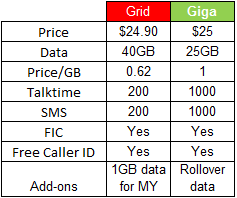
For the first part of this Telco Face-off series, I will be comparing Grid Mobile and Giga’s $25 Base Plan. Let’s get into it!
Network
Grid Mobile uses SingTel’s network while Giga uses StarHub’s network.
Telco Construct Comparison
Price-wise, there is no significant difference, with Grid Mobile being 10 cents cheaper per month.
However, data-wise, there is a huge difference, with Grid Mobile offering 40GB vs Giga’s 25GB. Grid Mobile initially offered 20GB at launch, so this 40GB data bundle is doubled of that. This drives down price/GB significantly for Grid Mobile.
On Grid Mobile’s website, it states that this 40GB will continue until further notice, so there is no end date at sight for that at the moment.
For talktime and SMS, Giga offers 5 times the amount of that of Grid’s offering.
Therefore, if you are a data-heavy, talktime-light user, Grid Mobile is probably the better bet for you. If you are a data-moderate, talktime-heavy user, Giga may better suit your needs.
However, if both bundles are suitable for you, what sets these 2 plans apart?
USP
Grid Mobile offers 1GB free data roam to Malaysia monthly while Giga has a data rollover feature which allows you to bring any unused data to the next month (max 25GB and over 2 months).
While data rollover may seem like a novel concept, it is actually an adaptation from Prepaid mechanics. Applied on Postpaid and this concept becomes pretty redundant.
Firstly, if you are unable to finish the bundle of 25GB in one month, it is unlikely that you would be able to finish 25GB + any rollover data in the next month. Continue rolling over and you will find that with or without data rollover, it does not impact your usage.
Secondly, the reason why data rollover is useful for Prepaid is because users can always spend lesser to roll over unused data, e.g. for M1, if you purchase a 2GB, 30-day plan for $10, you can rollover any unused data with a combination of 10MB, 7-day plan for just $1. However, for Giga, regardless of how much data you roll over, you will still need to pay $25 next month for the new 25GB that comes in, so there is no cost savings here.
Grid Mobile’s free 1GB to Malaysia every month, on the other hand, can come in pretty handy. With Johor Bahru just an hour away, you could always find a use for this free 1GB. Furthermore, the cheapest data roam to Malaysia is $5 for 1GB, so that’s a $5 cost saving there.
Other points to note
Grid Mobile also gives users 50 points every month just for staying on its network. Accumulate that for 2 months and you get $1 off your bill, not to mention that there are also extra points for your birthday and for any referral you make.
Verdict
While Giga’s bundle may be more useful for talktime-heavy users, overall Grid Mobile offers more value for its bundle, and with the price almost identical for both plans, Grid Mobile may be a better choice for the majority.
That’s all for today’s post! If you enjoy this post, please subscribe for the latest post!






 Singapore Telcos